Category: Poetry

  • An Apple a Day, the Tai Chi Way

    An Apple a Day, the Tai Chi Way

    Haiku

    an apple a day —
    tai chi, the peach of qigong
    its roots spreading, hundreds of years

    1️⃣ The AARP article, “8 Surprising Reasons to Try Tai Chi After 50,” contains several unexpected pieces of information, shown below, related to what patients had said at an American Geriatrics Society conference where they had shared “how tai chi had changed them.”

    “One woman who spoke was able to walk again after using a wheelchair for years. Another patient was able to stop using supplemental oxygen after just six months of regular tai chi.”

    That is not the first time I have read a story like that. It has been written that tai chi helped Cheng Man-Ching recover from what had been diagnosed as tuberculosis while he lived in China.


    2️⃣ More Reasons to Try Tai Chi

    An article linked with the BBC podcast, “Try Tai Chi” on Just One Thing, contains this:

    The ancient practice of Tai Chi is particularly popular in Hong Kong, where residents have one of the highest life expectancies in the world. Is this connected? Quite possibly. Those who practise Tai Chi regularly live significantly longer than those who don’t, according to a 2022 Shanghai study which followed 60,000 men for five years.

    The podcast, just under 15 minutes, is worth listening to. Its host, Michael Mosley, is a British doctor.


    3️⃣ Finally, a story about tai chi practiponer and teacher, Master T. T. Liang. The quote below is from the book, Steal My Art.

    In 1945 Liang was placed in a hospital because he had contracted pneumonia-which was complicated by the fact that he also had syphilis, gonorrhea, and a dysfunctioning liver. The diagnosis was very bad, and he was given no more than two months to live.

    T. T. Liang recovered, the hospital releasing him after a 45-day stay. To fully restore his health, he decided to study tai chi. Master Liang passed away in 2002 at age 102.


    4️⃣ I would like to share with you a poem Liang wrote.

    At first I take up T’ai Chi as a hobby,
    Gradually I become addicted to it,
    Finally I can no longer get rid of it.
    I must keep on practicing for my whole life—
    It is the only way to preserve health.
    The more I practice, the more I want to learn
    from teachers and books.
    The more I learn, the less I feel I know.
    The theory and philosophy of T’ai Chi is so
    profound and abstruse!
    I must continue studying forever and ever . . .
    It is the only way to improve and better myself.


    Discussion of Haiku at Top of Page

    1. “An apple a day”— This line is a familiar saying that tells us eating an apple every day is good for our health. It sets the idea of something healthy and regular, just like practicing Tai Chi.
    2. “Tai chi, the peach of qigong”— Here, Tai Chi is compared to a peach, which symbolizes health and strength. Just like how a peach grows from a tree with strong roots, Tai Chi comes from Qigong, an ancient practice that helps us build strength inside and out.
    3. “Its roots spreading, hundreds of years”— This line shows that Qigong and Tai Chi have been practiced for a very long time. The “roots” represent the deep history and traditions that support Tai Chi, like how a tree’s roots spread out under the ground for many years.

    In simple terms, this haiku compares Tai Chi to a peach, which grows from strong roots and has been around for hundreds of years, just like Tai Chi’s long and deep history. It’s saying that, like healthy habits (like eating an apple), Tai Chi is good for you and has deep roots in ancient traditions.
  • Haiku: Harmony of Tai Chi

    Haiku: Harmony of Tai Chi

    I’ll start this post with a poem that contributor Howard Rosenberg wrote and then share my thoughts about it.


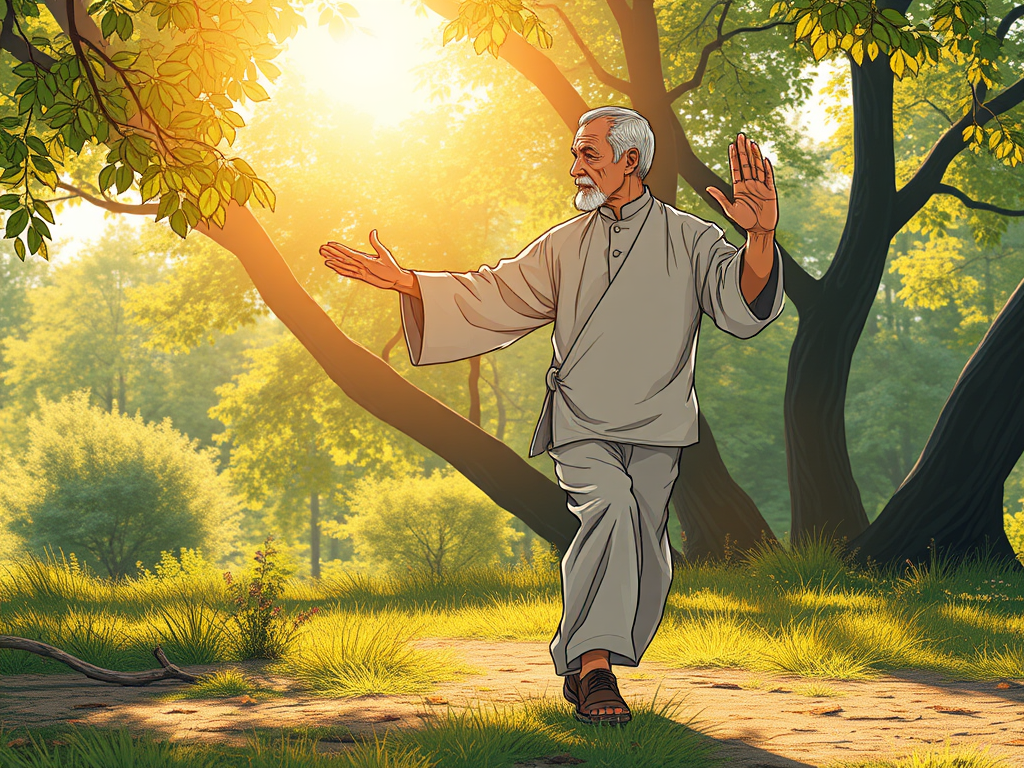
    Warm breeze spreads the leaves
    arms rise—palms hide from the sun
    breath drifts out and back

    Introduction

    The haiku reflects the harmony between movement, breath, and nature in Tai Chi. Each line emphasizes how Tai Chi is a practice of gentle, flowing action, where the practitioner moves in sync with their body and the world around them. The imagery of the breeze, the rising arms, and the drifting breath conveys a sense of calm, balance, and interconnectedness.

    It reminds us that Tai Chi is not just a physical exercise but also a mindful, unifying one, where every movement is in harmony with both the body within and the environment without.

    This opening line creates a tranquil, natural scene, evoking calm and openness. The breeze reflects Tai Chi’s gentle, unhurried flow, moving with grace. The image of leaves spreading suggests the gradual, controlled expansion of a Tai Chi movement—like arms extending outward in a smooth, near-effortless flow—allowing energy to unfold naturally rather than being pushed or strained.

    Arms rise—palms hide from the sun

    In Tai Chi, movements are not rigid or isolated; they flow in sync with external forces like gravity, air, and even the presence of others. The phrase “palms hide from the sun” suggests an intentional response to light, as if the practitioner is adjusting to the natural world rather than resisting it. This reflects Tai Chi’s emphasis on adapting to external conditions, much like how water flows around obstacles instead of pushing through them.

    Instead of moving mechanically, Tai Chi encourages practitioners to be in tune with the energy around them, similar to how a leaf sways with the wind rather than standing stiffly against it.

    The act of concealing the palms could symbolize an awareness of changing forces, much like shading one’s eyes when the sun is bright—not as a reaction of discomfort, but as a natural adjustment.

    This motion is not just about physical movement but about being present and responding to the moment. Tai Chi practitioners adjust their movements based on breath (not all do), balance, and external influences, reinforcing the idea that the practice is about flowing with the world rather than against it.

    A Tai Chi practitioner is “attuned to the environment,” moving with awareness, adaptability, and balance, as is done when they adjust their palms to the sun, shift their stance with the breeze, or move in harmony with gravity. It’s about being fully present and responsive to the world around them.

    Breath drifts out and back

    Breath is not just a physical function but an integral part of Tai Chi. Even when breathing is not directly integrated into movement, such as inhaling while raising the arms, checking the diaphragm to ensure you’re breathing into the belly rather than the chest can foster mindfulness and strengthen the connection between body and mind.

  • Presence in Poetry and Tai Chi

    Presence in Poetry and Tai Chi

    An invisible thread lifts
    the crown of my head,
    its mind-made pull
    creating space
    for relaxation to grow.

    Stanza in the poem “Root, Feel, Flow” by Howard Rosenberg

    Both poetry and tai chi emphasize presence—being fully aware of and engaged in the moment. In tai chi, every movement is deliberate, connected to intention and often breath. The practitioner is not rushing to the next motion but fully inhabiting the present one. Similarly, poetry demands attention to each word, each pause, and the rhythm created by both what is said and what is left unsaid.

    Meaning in both forms is not just in the obvious actions—the movements in tai chi or the words in poetry—but also in the spaces between. In tai chi, the transition between movements, the moment before shifting weight, and the softness between exertions hold as much significance as the motions themselves. Likewise, in poetry, the silence between lines, the choice of line breaks, and the unstated emotions lingering in white space shape the poem’s impact.

    In this way, both tai chi and poetry cultivate a deep awareness of the present, where understanding comes not just from doing, but from sensing, feeling, and existing fully in the moment.


    “Root, Feel, Flow” is about the Preparation movement.


    Root, Feel, Flow

    My feet shoulder-width apart,  
    soldiers to my intent—my yi
    pronounced like "e" in English,
    awake, waiting . . .

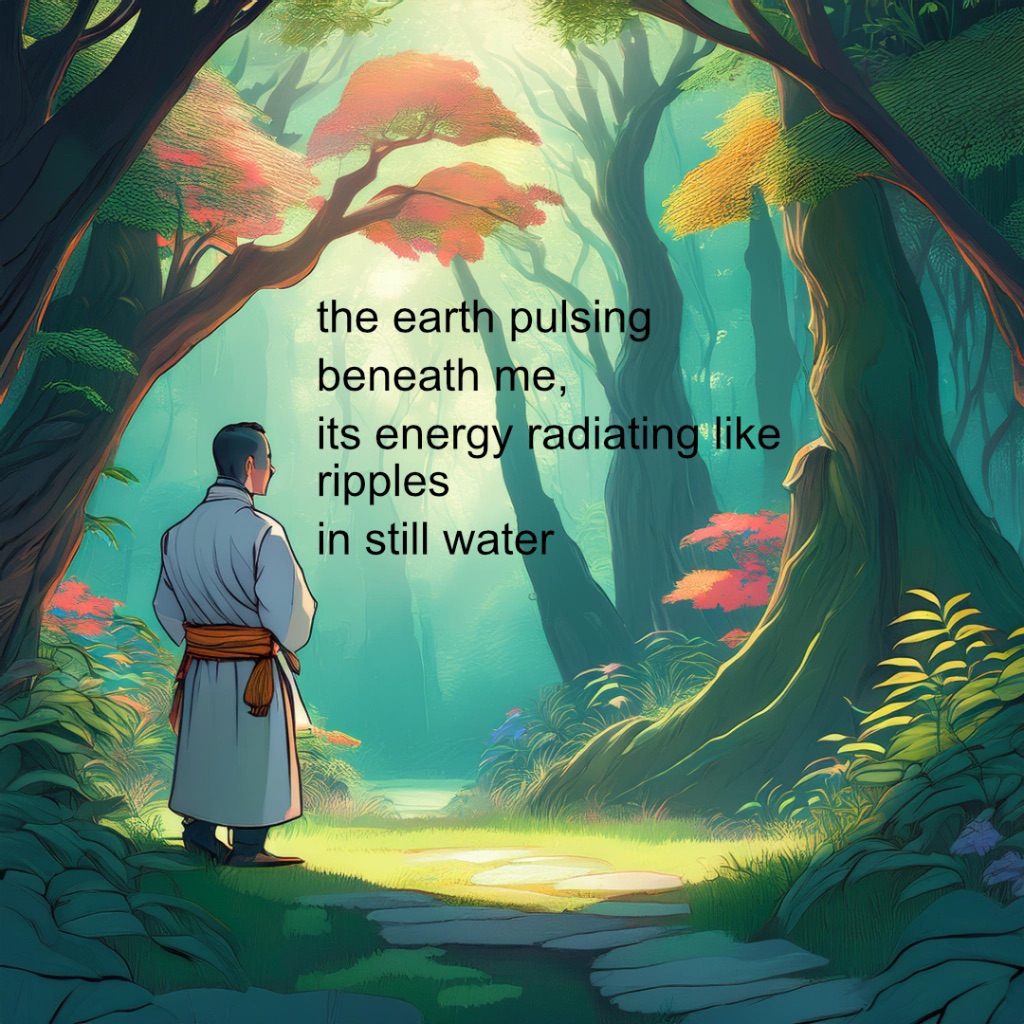
    the earth pulsing
    beneath me
    its energy radiating like ripples
    in still water,

    extending umbilical cords
    into my two "bubbling wells,"
    one in each sole,
    connecting us,

    its message transmitted
    in a language few can feel,
    its touch grounding me.

    An invisible thread lifts
    the crown of my head,
    its mind-made pull
    creating space
    for relaxation to grow.

    An unseen weight,
    a fisherman’s sinker,
    anchored deep at my tailbone,
    lowers me with the ease of a tide
    receding, yielding
    to the sea.

    My body settles,
    no leaning,
    my breath barely stirring the air,
    ready . . .

    my arms float
    toward the sky,
    slow as a caterpillar's crawl,
    wrists leading the rise,
    each motion fluid, unhurried,
    guided by the mighty yi.

    Allen Ginsberg, a famous poet of the Beat Generation in the fifties and sixties, was a defining voice of his era. He wrote a poem titled “Allen Ginsberg Does Tai Chi.” You can watch Ginsberg reciting the poem here and read its text here.