Category: Health

  • Tai Ji Quan Can Enhance Memory

    Tai Ji Quan Can Enhance Memory


    Besides teaching Tai Chi to seniors, I also like to keep up with health-related research findings in both Tai Chi and Qigong. The latest article I came across is on the NPR website, titled: Tai chi helps boost memory, study finds. One type seems most beneficial.”
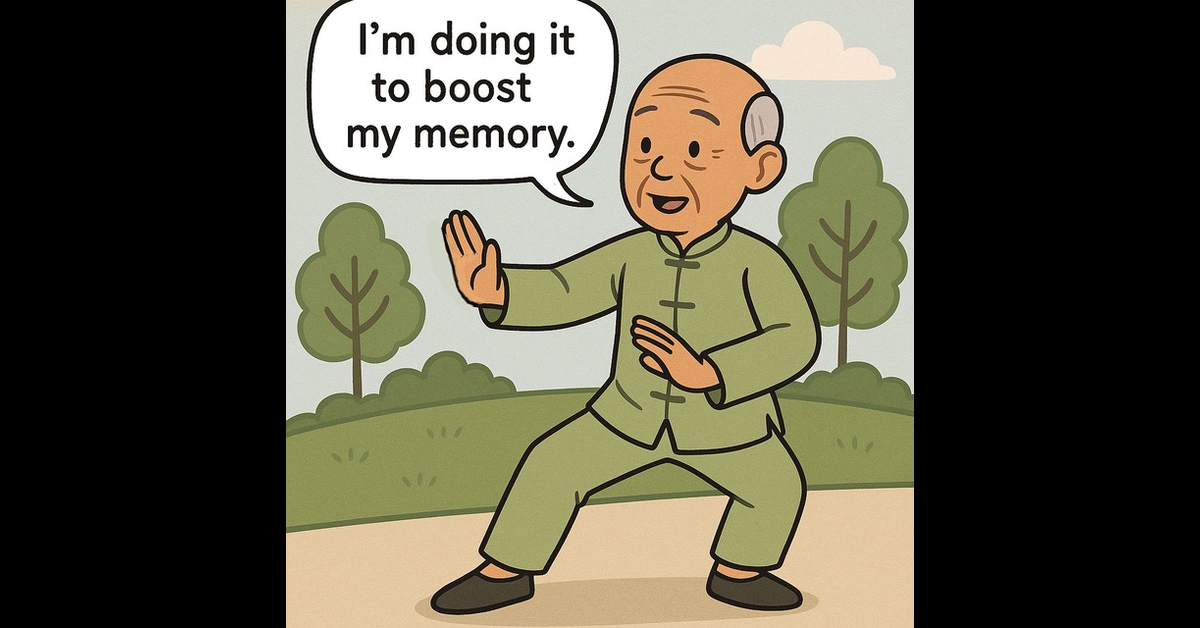
    I was curious about what that “type” was, as I had never heard that distinction made before.

    The article’s author, Allison Aubrey, mentions that the study used a “simplified form of tai chi called Tai Ji Quan” (see bottom of page). However, Tai Chi is simply the popular or Westernized name for Tai Ji Quan (also spelled Tai Chi Chuan), which is the original Chinese term, not the name of one form. Tai Chi encompasses a wide range of forms.

    There are indeed simplified versions of Tai Chi Chuan—for example, the Simplified 24-Form Tai Ji Quan was created in 1956 in China to make Tai Chi more accessible to the public for health and exercise. I taught that form for a number of years and co-authored a book about it.

    Curious about which form was used in the study, I tracked down the original research on the Annals of Internal Medicine website. I found that the study participants learned eight forms apparently assembled specifically for the study. There was no mention of how well these forms transitioned into one another, unlike in established forms such as Cheng Man-Ching’s 37 Movement Form, where smooth transitions are a hallmark.

    In the NPR article, Dr. Elizabeth Eckstrom, one of the doctors involved in the study, shared her thoughts on how Tai Chi might help with memory improvement.

    Aubrey wrote,

    “Her theory [Dr. Eckstrom’s] on why tai chi is effective is that it combines the memorization of the movements, known as forms, almost like a dance choreography. ‘So, you’re getting the physical activity, plus the memory piece.’”

    A study participant also shared her personal experience:

    “‘It becomes a meditative practice,’ says Mary Beth Van Cleave, 86, who lives in a retirement community with her wife and their cat in the Portland, Ore., area. She started tai chi at age 75 and says her practice helps her feel grounded and enables her to let go of stress. ‘It’s become an important part of my life,’ Van Cleave says.”

    She added, “In terms of a cognitive boost, she thinks tai chi helps with concentration. ‘I’m more conscious of trying to do one thing at a time.’”

    Later in the article, Aubrey shares how Tai Chi is often misunderstood, again quoting Van Cleave:

    “If you’ve never done tai chi, which is a martial art that incorporates a series of movements, known as forms, with a focus on controlled breathing, too, it may look like nothing much is happening. But that’s a misconception, Van Cleave says. ‘We are working very hard,’ she explains. And, she says, the physical benefits are pronounced.”

    “‘There are so many times I’ve avoided a fall,’ she says. ‘That’s because of the balance that tai chi gives me.’”

    Whether you’re new to Tai Chi or a skilled practitioner, the NPR article is well worth reading. It not only highlights the benefits of the practice, but also reminds us that Tai Chi is more than slow movement.

    It’s a tool worth acquiring at any age, even later in life.


    Tai Ji Quan is pronounced like tie jee chwan.

    • Tai sounds like “tie”, like when you tie your shoes.
    • Ji sounds like “jee”, like the word jeep.
    • Quan sounds like “chwan”, like “ch” in chocolate and “wan” like wand (but a little softer).

    This is how it is said in Mandarin Chinese, and it’s the real name for what many people call “Tai Chi.”

  • Tai Chi and Qigong Can Lessen Low Back Pain

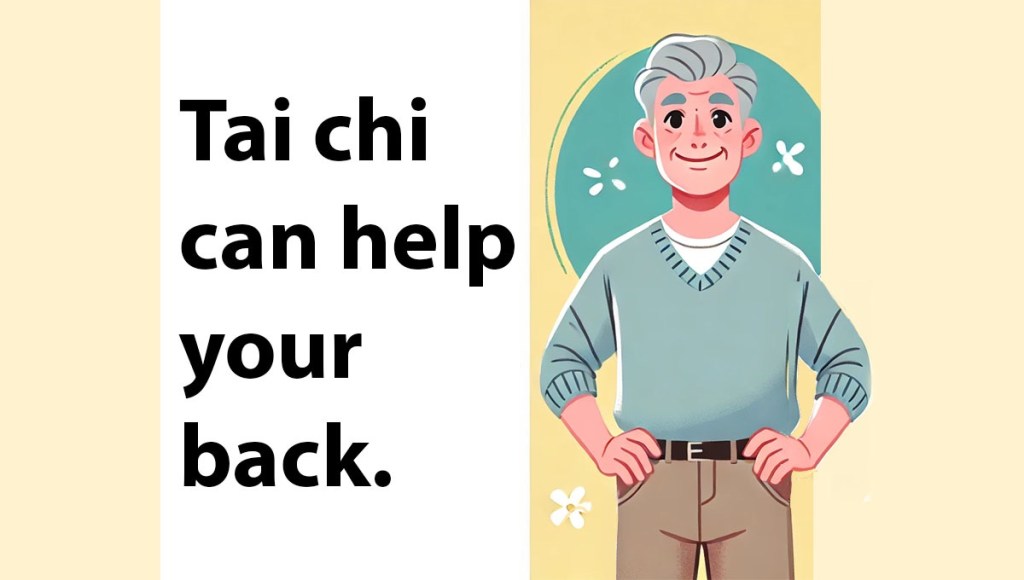
    Tai Chi and Qigong Can Lessen Low Back Pain

    Years ago, during one of my visits to the Taste of China tai chi event in Winchester, Virginia, I met Grandmaster Yang Yang. Recently, I came across his name again. Today, he directs the Center for Taiji and Qigong Studies in New York, an organization he founded. It conducts scientific research on both tai chi and qigong.

    Among its research studies is one published in the North American Spine Society Journal and called “A tai chi and qigong mind-body program for low back pain: A virtually delivered randomized control trial.”

    The study had 350 participants with 79% female. To partake in the study you had to have “LBP for at least six weeks” where LBP is low back pain.

    Here are some of the study’s key findings. Among them are that 40% of the participated reported less pain, 19% reported sleeping better, and 22% reported that it improved their quality of life.


    An article about the study appeared in thetimes.com. Titled “Bad back? Why t’ai chi and qigong could help,” it opens with this:

    “If you’re one of the millions of people in the UK who suffer from a bad back, there could be a solution at hand that’s more than 4,000 years old.”

    The article then

    “shows that when combined with meditation, qigong and t’ai chi — related ancient Chinese practices involving flowing movements, careful body posture and breathing — are effective at reducing lower-back pain.”


    Harvard Medical School published the related article, “Proper posture the tai chi way.” It states that

    “in tai chi, good posture centers around the principle of verticality. That means the head is centered over the torso, the torso rests over the hips, and the hips are centered over the legs and feet, your base of support.”

    The article gives details related to doing that. Within its description is this quote: “Tai chi classics say, ‘The spine should be like a necklace of pearls hanging from heaven.’”


    The Tai Chi Classics describe the spine as “a necklace of pearls hanging from heaven” to emphasize natural alignment, relaxation, and a balanced connection between heaven and earth.

    Here’s why the image of the pearls is meaningful:

    1. Effortless Suspension – The metaphor suggests that the head is gently lifted, as if suspended from above, allowing the spine to hang naturally. This prevents tension and compression, promoting better posture and energy flow.
    2. Smooth, Flexible Connection – Like a string of pearls, the vertebrae should be evenly spaced and mobile, not stiff or locked. This enables smooth energy (qi) circulation and fluid movement in Tai Chi.
    3. Relaxation & Rooting – When the spine hangs naturally, the body relaxes, and weight sinks properly into the ground. This balance between upward suspension and downward rooting creates stability and ease in movement.
    4. Energy Flow (Qi Flow) – Proper spinal alignment allows qi to rise effortlessly and sink smoothly, much like a current flowing through an unobstructed channel.

    By visualizing the spine as a hanging necklace rather than a rigid column, Tai Chi practitioners develop a balance of structure and relaxation, allowing for graceful, efficient movement.

  • Transform Your Qi Awareness

    Transform Your Qi Awareness

    Can a two and a half minute exercise, if done for 45 days, change your feeling awareness? It basically involves relaxing and then moving the arms in a circular motion while gently bending the legs and doing several simple visualizations.

    It’s easy to learn the activity. To start, watch the video “Song In Tai Chi: Becoming A Yin Yang Superconductor (A Qigong Lesson)” on the Pacific Mountain Tai Chi site. Then, practice the movement twice a day for 45 days to “completely awaken [your] Yin and Yang,” according to Zongqing Lin.

    Any time after you start practicing, if you would like, share your experience via the Comment box below.

    Lin says that

    “In this Yin and Yang Transformation Qigong, you will learn to create the qualities of Yin and Yang in your Qi, in a manner that lets you deeply experience them and fully awaken these qualities within yourself.”

    ➡️ Lin also refers to the practice as “Yin and Yang Flowing Qigong.”


    Yin-Yang and Tai Chi


    In the description accompanying Lin’s video, he wrote this about one connection between Yin and Yang and tai chi:

    “Yin and Yang are qualities that things can have. Have you ever considered that your Qi can also have qualities of Yin and Yang? Indeed the mastery of your ability to control these polar opposite qualities of energy is the basis of the name Tai Chi, which literally means Extreme Polarities.”


  • An Apple a Day, the Tai Chi Way

    An Apple a Day, the Tai Chi Way

    Haiku

    an apple a day —
    tai chi, the peach of qigong
    its roots spreading, hundreds of years

    1️⃣ The AARP article, “8 Surprising Reasons to Try Tai Chi After 50,” contains several unexpected pieces of information, shown below, related to what patients had said at an American Geriatrics Society conference where they had shared “how tai chi had changed them.”

    “One woman who spoke was able to walk again after using a wheelchair for years. Another patient was able to stop using supplemental oxygen after just six months of regular tai chi.”

    That is not the first time I have read a story like that. It has been written that tai chi helped Cheng Man-Ching recover from what had been diagnosed as tuberculosis while he lived in China.


    2️⃣ More Reasons to Try Tai Chi

    An article linked with the BBC podcast, “Try Tai Chi” on Just One Thing, contains this:

    The ancient practice of Tai Chi is particularly popular in Hong Kong, where residents have one of the highest life expectancies in the world. Is this connected? Quite possibly. Those who practise Tai Chi regularly live significantly longer than those who don’t, according to a 2022 Shanghai study which followed 60,000 men for five years.

    The podcast, just under 15 minutes, is worth listening to. Its host, Michael Mosley, is a British doctor.


    3️⃣ Finally, a story about tai chi practiponer and teacher, Master T. T. Liang. The quote below is from the book, Steal My Art.

    In 1945 Liang was placed in a hospital because he had contracted pneumonia-which was complicated by the fact that he also had syphilis, gonorrhea, and a dysfunctioning liver. The diagnosis was very bad, and he was given no more than two months to live.

    T. T. Liang recovered, the hospital releasing him after a 45-day stay. To fully restore his health, he decided to study tai chi. Master Liang passed away in 2002 at age 102.


    4️⃣ I would like to share with you a poem Liang wrote.

    At first I take up T’ai Chi as a hobby,
    Gradually I become addicted to it,
    Finally I can no longer get rid of it.
    I must keep on practicing for my whole life—
    It is the only way to preserve health.
    The more I practice, the more I want to learn
    from teachers and books.
    The more I learn, the less I feel I know.
    The theory and philosophy of T’ai Chi is so
    profound and abstruse!
    I must continue studying forever and ever . . .
    It is the only way to improve and better myself.


    Discussion of Haiku at Top of Page

    1. “An apple a day”— This line is a familiar saying that tells us eating an apple every day is good for our health. It sets the idea of something healthy and regular, just like practicing Tai Chi.
    2. “Tai chi, the peach of qigong”— Here, Tai Chi is compared to a peach, which symbolizes health and strength. Just like how a peach grows from a tree with strong roots, Tai Chi comes from Qigong, an ancient practice that helps us build strength inside and out.
    3. “Its roots spreading, hundreds of years”— This line shows that Qigong and Tai Chi have been practiced for a very long time. The “roots” represent the deep history and traditions that support Tai Chi, like how a tree’s roots spread out under the ground for many years.

    In simple terms, this haiku compares Tai Chi to a peach, which grows from strong roots and has been around for hundreds of years, just like Tai Chi’s long and deep history. It’s saying that, like healthy habits (like eating an apple), Tai Chi is good for you and has deep roots in ancient traditions.

  • Cheng Man-Ching, Ben Lo, and Young Lee

    Cheng Man-Ching, Ben Lo, and Young Lee

    It’s uncommon to read about an 87 year old who does tai chi. It is even rarer to learn about a person that age who teaches tai chi, but that is what Young Lee does in Maryland.


    In this Mayo Clinic Minute video, a doctor shares why “Mayo Clinic Minute: “Tai chi keeps seniors on their feet.”


    I found another excellent video of Cheng Man-Ching doing tai chi. When watching it, pay particular attention to how precisely he does the turns.


    A tai chi teacher who is not as well known as Cheng Man-Ching is Benjamin Lo. He was a student of Cheng Man-Ching in Taiwan. This short video is about both tai chi and Lo who, in the video, is in his late 70s.