Besides teaching Tai Chi to seniors, I also like to keep up with health-related research findings in both Tai Chi and Qigong. The latest article I came across is on the NPR website, titled: “Tai chi helps boost memory, study finds. One type seems most beneficial.”
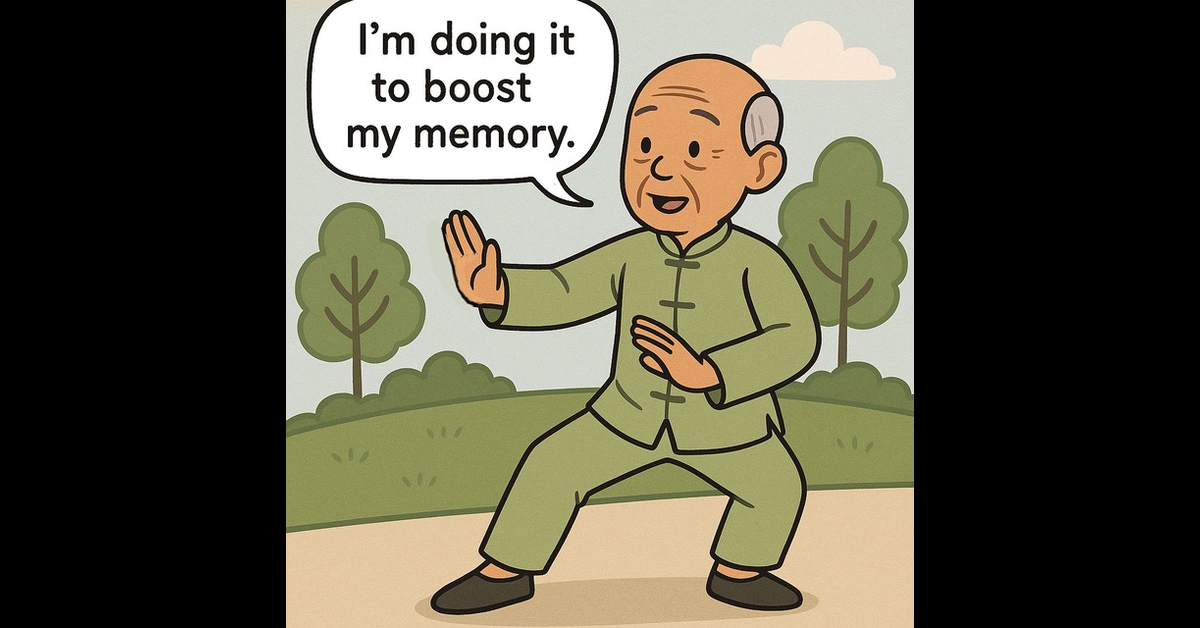
I was curious about what that “type” was, as I had never heard that distinction made before.
The article’s author, Allison Aubrey, mentions that the study used a “simplified form of tai chi called Tai Ji Quan” (see bottom of page). However, Tai Chi is simply the popular or Westernized name for Tai Ji Quan (also spelled Tai Chi Chuan), which is the original Chinese term, not the name of one form. Tai Chi encompasses a wide range of forms.
There are indeed simplified versions of Tai Chi Chuan—for example, the Simplified 24-Form Tai Ji Quan was created in 1956 in China to make Tai Chi more accessible to the public for health and exercise. I taught that form for a number of years and co-authored a book about it.
Curious about which form was used in the study, I tracked down the original research on the Annals of Internal Medicine website. I found that the study participants learned eight forms apparently assembled specifically for the study. There was no mention of how well these forms transitioned into one another, unlike in established forms such as Cheng Man-Ching’s 37 Movement Form, where smooth transitions are a hallmark.
In the NPR article, Dr. Elizabeth Eckstrom, one of the doctors involved in the study, shared her thoughts on how Tai Chi might help with memory improvement.
Aubrey wrote,
“Her theory [Dr. Eckstrom’s] on why tai chi is effective is that it combines the memorization of the movements, known as forms, almost like a dance choreography. ‘So, you’re getting the physical activity, plus the memory piece.’”
A study participant also shared her personal experience:
“‘It becomes a meditative practice,’ says Mary Beth Van Cleave, 86, who lives in a retirement community with her wife and their cat in the Portland, Ore., area. She started tai chi at age 75 and says her practice helps her feel grounded and enables her to let go of stress. ‘It’s become an important part of my life,’ Van Cleave says.”
She added, “In terms of a cognitive boost, she thinks tai chi helps with concentration. ‘I’m more conscious of trying to do one thing at a time.’”
Later in the article, Aubrey shares how Tai Chi is often misunderstood, again quoting Van Cleave:
“If you’ve never done tai chi, which is a martial art that incorporates a series of movements, known as forms, with a focus on controlled breathing, too, it may look like nothing much is happening. But that’s a misconception, Van Cleave says. ‘We are working very hard,’ she explains. And, she says, the physical benefits are pronounced.”
“‘There are so many times I’ve avoided a fall,’ she says. ‘That’s because of the balance that tai chi gives me.’”
Whether you’re new to Tai Chi or a skilled practitioner, the NPR article is well worth reading. It not only highlights the benefits of the practice, but also reminds us that Tai Chi is more than slow movement.
It’s a tool worth acquiring at any age, even later in life.
Tai Ji Quan is pronounced like tie jee chwan.
- Tai sounds like “tie”, like when you tie your shoes.
- Ji sounds like “jee”, like the word jeep.
- Quan sounds like “chwan”, like “ch” in chocolate and “wan” like wand (but a little softer).
This is how it is said in Mandarin Chinese, and it’s the real name for what many people call “Tai Chi.”
 Tai Chi Moves
Leave a comment